
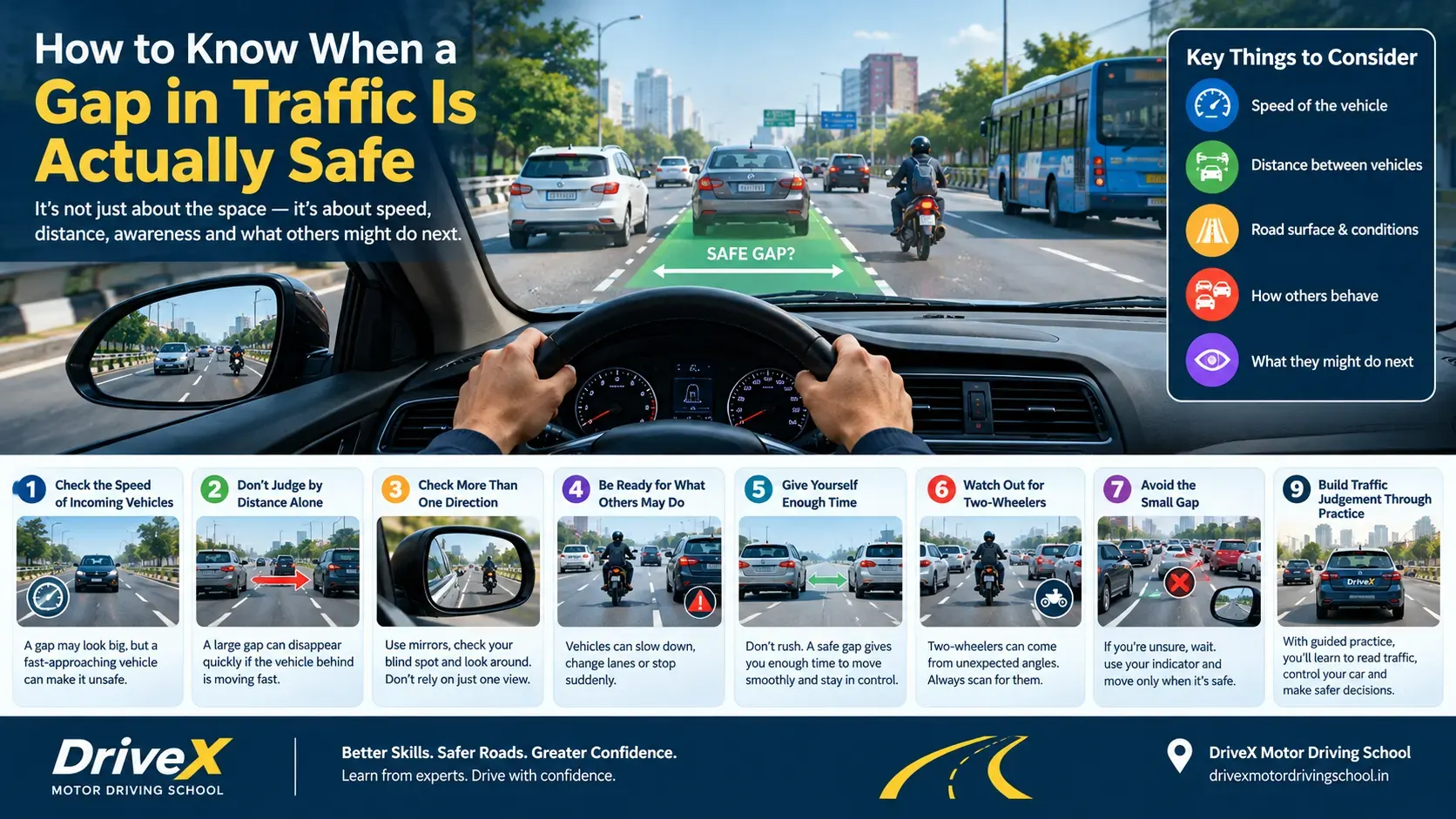
Knowing when a gap in traffic is safe — and when it’s not, even if it looks like one to you as an experienced driver. Beginners are very good at learning to steer, brake the car, push on their accelerator pads and even shift gears in manual but when it comes time to cavalier themselves into moving traffic or change lanes, make a turn or cross a busy road start doubting. A safe gap is not just looking at the distance between two vehicles. You have to take into account other factors like speed of the vehicle, distance from it road surface features Flow how others behave on a public transport and what they will do next.
Check the Speed of Incoming Vehicles
A gap which might seem ample in size is nevertheless unsafe if the greedily approaching vehicle is travelling very fast. Likewise, when traffic is slow a little gap often has time to spare. Which is why new drivers who are learning to judge not only distance but speed as well need to look beyond the empty space.
When entering traffic, check the cars and motorcycles that are approaching buses more carefully! Questions to ask yourself — do you have enough time while moving in the road without making another driver brake or change direction suddenly? On large roads along with Delhi traffic speed is deceptive.
DO NOT JUDGE A GAP BY ONLY DISTANCE
Assuming a gap is safe because there appears to be enough room is one of the most common beginner driving mistakes. How safe that gap in the traffic is depends entirely on how fast was coming up and how long it would take you to get into the flow of things.
So, if the gap between 2 vehicles is huge then the vehicle behind that gap might close up very quickly when travelling at speed (for example). The time gap between vehicles is comfortable enough to make the move without any rush in a safe manner.
Check More Than One Direction
Do not look in one direction before entering a busy road or changing lanes. Take a good look in your mirrors, and around you. Watch out for everything that might be coming up behind you Another car or bus will also be able to perform these tasks hidden by a larger vehicle: motorcycle riding between lanes, bicycles and pedestrians.
Especially when you make lane changes on the road. Prior to moving, look in rear-view carry out a head check-over your shoulder also this would include side mirror and blindspot. What looks like a safe gap in the mirror can become unsafe if you cannot see what is coming from your blind spot, and that includes motorcycles.
Brace Yourself For What Other Drivers May Do
Traffic does not always flow as predicted. A vehicle travelling at a constant speed can suddenly slow down, merge change lanes turn or come to rest. A motorcycle could go into the gap you were intending to occupy.
Defensive driving means anticipating what another user may do next (they will not hold their speed line and direction) It becomes even more crucial on congested roads since movement of vehicles can change in the blink of an eye.
Own the Time to Get in the Gap
A safe gap, therefore, would be sufficient to enable your vehicle to merge easily and without issues into oncoming traffic. Do not be in a hurry because you are concerned about the gap disappearing. Sudden acceleration can be difficult to control and catch other drivers off guard.
When learning to drive, both practice entering traffic at a controlled rate and learn under the supervision of an experienced instructor. This will teach you how much gap your car needs and it helps in traffic judgement to improve.
Be Extra Careful Around Two-Wheelers
Two-wheelers are a key part of traffic in cities like Delhi and many others with high population density. Another is that motorcycles and scooters can weave through tighter quarters, but they may come from unexpected angles.
Scan for two-wheelers while assessing a gap Never assume that a space between cars is totally empty. It could be a motorcycle passing next to another vehicle or approaching from the rear.
It is all about learning to spot motorcycles, scooters and other low — profile vehicles Go all the way at full speed from overtaking larger cars driving in heavy traffic — especially for city riding.
Gap 2: The Small Gap (Do not force yourself into)
Whenever you are uncertain whether a gap is safe, it pays to wait. For new drivers especially, it can feel pressured when vehicles behind are honking; you should never enter a hazardous gap simply because another driver is impatient.
An extra few seconds to prepare gives a much better perspective on your chance. In terms of safe driving, moving first is not the answer against a slow reaction time and high-impact on interaction; it only poses control—and thus enabling you to avoid or produce danger.
Judging the gaps while changing a lane
Not only indicating — safely changed lane You must find a good gap, check mirrors, blind spot checking (see my other article about that), use your indicator and move slowly when it is safe.
Not cut into a gap that will cause the driver in the vehicle behind to apply emergency braking If there is another car coming at a great speed, allow it to pass and check traffic before changing lanes.
Build Traffic Judgement Through Practice
With experience, it becomes easier to judge traffic gaps but novice drivers can learn this skill faster through structured driving practice. A licensed instructor describes vehicle speed, following distance, lane positioning and use,braking braking points to maintain safety from blind spots that arises while driving on the road when decision making needs to be extremely safe.
DriveX Motor Driving School helps you to learn practical driving skills with more confidence for normal day-to-day road conditions in Delhi. Although some of the basic car controls are taught, there is an aspect to driving that cannot be practiced virtually; how traffic acts in real-time — and this can easily get lost when stacking beginners into a single test track.
In the end, it is down to observation and patience and speed awareness coupled with a good judgement of timing; if one can never actually know whether or not there is a safe gap in traffic. Don’t just pay attention how much you can see Evaluate how close cars are getting to you, what other road users may do as well and whether or not they have enough time for that movement. As any beginning driver with enough practice driving defensive driving skills and proper traffic awareness can be much more comfortable judging gaps better.