
The process of learning how to turn a car in a tight space may seem daunting if you have yet to master the use of the steering wheel, accelerator/brake pedals and the dimensions of your vehicle. The 3-point turn is an essential driving technique used by drivers who need to alter their course in areas where there isn’t sufficient room to perform a traditional U-turn. Unfortunately, many new drivers find it challenging to maintain control over their steering, assess the distance to the curb, and determine at what point they should halt the vehicle and reverse.
If you are able to master the skill of making a safe three point turn, and have practiced it enough times, you will be able to do so without damaging either the side of the road (kerb) or your vehicle.
What Is a Three-Point Turn?
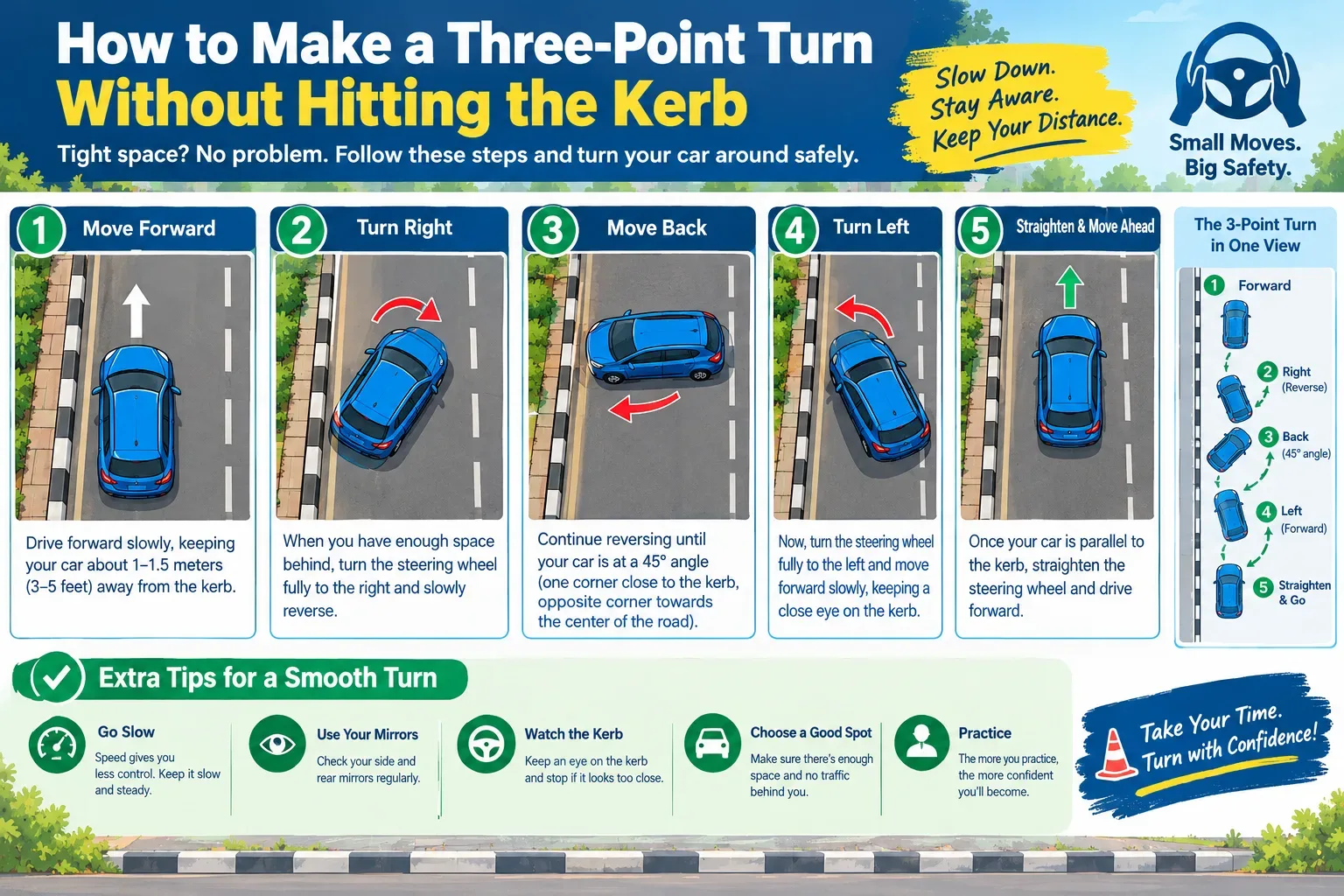
A three-point turn, also known as a “turn about,” is a maneuver that allows you to reverse your car in a small area. This type of turn typically includes driving forward, backing up, and then driving forward once more to complete the reversal.
The three-point turn is particularly suited for narrow residential streets and less busy roads where it’s difficult to make a complete U-turn. Learning how to perform a three-point turn will help a learner driver improve their ability to control their car, back up safely, and understand how much room they have around their car.
Prior to performing the above mentioned maneuver on a public street, verify that the area where you will perform it is secure, lawful, and there are no vehicles approaching.
Why Do Beginners Hit the Kerb During a Three-Point Turn?
A very common error is to turn the steering wheel either too fast or too slow. Beginners tend to concentrate on the front of the vehicle and neglect the fact that the rear tires will follow a separate route when turning.
A second issue is underestimating how much space there is on the road. From the perspective of the driver, the vehicle will seem like it has plenty of space; however, the front bumper or rear wheel could come in contact with the curb.
Difficulty with reversing may occur due to improper use of mirrors, rushing through the maneuver, and/or failing to check around you prior to reversing. Moving slowly, observing your surroundings, and stopping when you have questions regarding the amount of space available is the best method to use.
How to Perform a Three-Point Turn Safely
Choose a Suitable Place
Practicing should begin in an open, quiet space with plenty of room to move around. You want to avoid using roads that are very busy, have tight turns, are steep, or where your vehicle may block other vehicles from traveling.
Scan the area around you for pedestrians, parked cars, cyclists, and any other potential hazards. Before you start driving, make sure that your seat is positioned correctly, and adjust all of your mirrors so that you have a clear view of what lies ahead of you and are able to easily use the controls of your vehicle.
Move Forward Slowly
Begin by walking into the street, check both directions (ahead and behind), signal as needed, and then walk into the street. Turn the front wheels in the direction that you want to travel, using the safety methods shown to you by your driving instructor.
Keep watching the two front corners of your car and how far away from the curb you are. Do not let the car hit anything. You do not have to steer quickly or speed up quickly.
Reverse With Care
Secure the car prior to engaging reverse once you have arrived at a safe stopping point. Examine the area surrounding the car; particularly the side and rear, looking for pedestrians or other items that are not visible through your mirror.
Slowly back up while turning your steering wheel in the direction you want to turn your car. As you do this, remember that the front end of your car will move toward the other side, therefore, look at both the front and back of your car.
Stop and assess your surroundings if you find yourself in a confined area, instead of moving forward blindly. Although reversing cameras and parking sensors are helpful, there is nothing that replaces having a direct view of the area.
Move Forward to Complete the Turn
When you have ample space to turn around, make sure that it is safe for you to stop your vehicle. Then, choose the proper gear to use. Once you have chosen the proper gear, check your surroundings once again prior to making your move.
Gradually turn into the new direction, then straighten the steering wheel once the car is aligned with the road. Before you do anything else, look for traffic that may be coming and make sure you are in a safe position.
Tips to Avoid Hitting the Curb
The best way to avoid hitting the kerb is to control your speed and not to drive too fast.Small steering corrections are easier to make than rapid ones, especially when space is limited.
Be aware of both ends of your car. Your front bumper has the potential to move outward when you are driving in reverse, and your back tires could potentially get closer to the sidewalk than you anticipate. Check your mirrors frequently, and directly observe what is happening around your car as long as it is safe to do so.
If you can’t finish the turn with the available room, stop and look again. There might be a need for another change of direction or position, as opposed to making the car fit.
Improve Your Turning Skills With Driving Lessons
Learning how to perform a three-point turn is much simpler if you are properly trained. A qualified driving instructor will help you to understand the correct steering movements, clearance of the vehicle, reverse techniques and proper observation.
The regular instruction that is offered at Drivex Motor Driving School will allow you to develop practical driving skills while gaining self-confidence. Regular practice can also assist in enhancing your ability to park, reverse, position yourself properly on the road and manage your vehicle on narrow streets.
Practise Slowly and Drive With Confidence
A three-point turn isn’t about being fast; it’s about control of the vehicle, assessing the space, and maintaining awareness of what’s happening around you. Practice at a slow pace . Look around you and adjust if needed . You will learn how to turn around safely without hitting the sidewalk .
Practice in a safe controlled environment before you head into heavy traffic. Learning good habits when learning to drive can help you to have a safer and easier experience when you are out there on the road.