
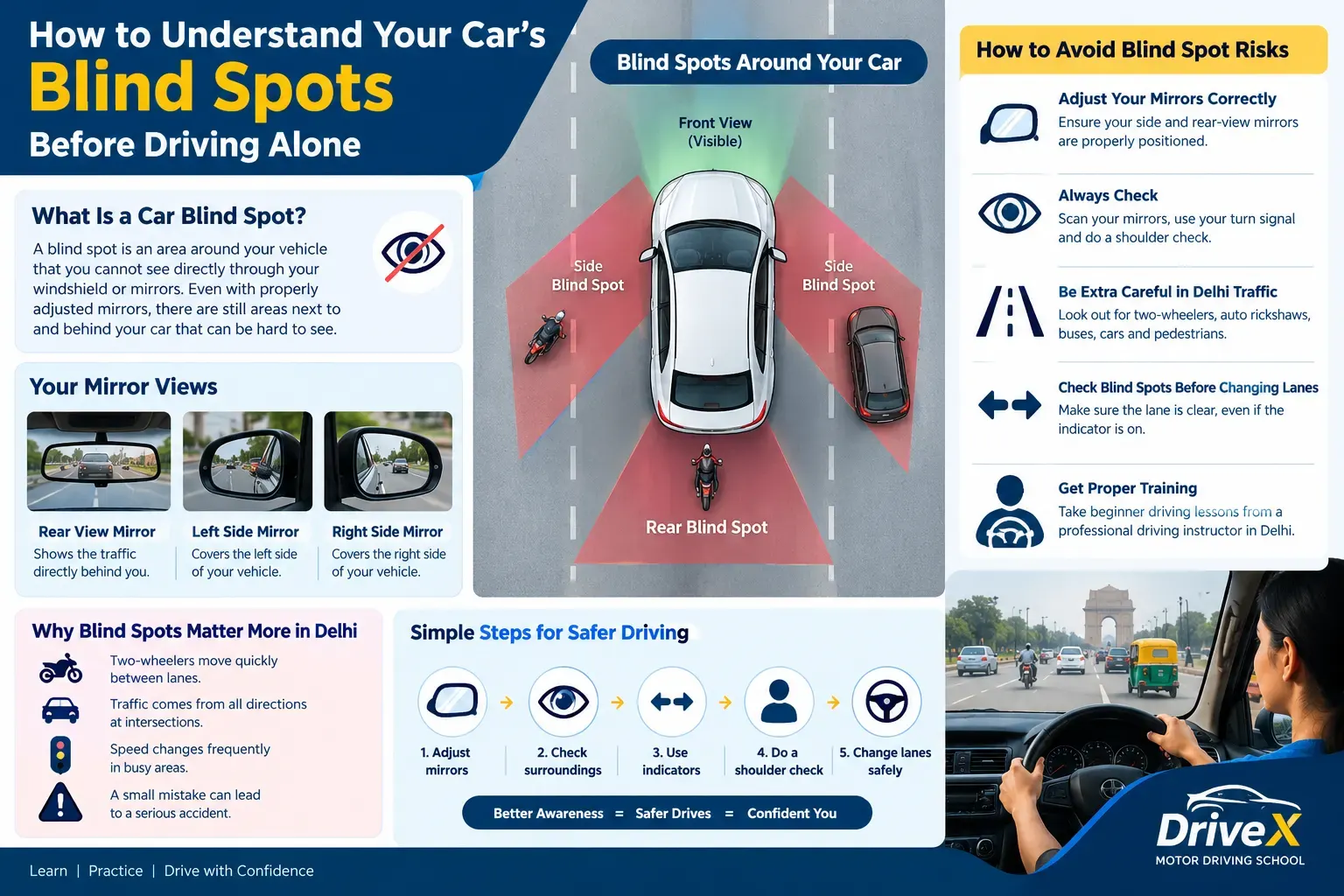
As a first-time driver, there is a certain level of excitement that comes with operating a vehicle independently. However, along with that excitement, there are some responsibilities as well, such as understanding the area surrounding your vehicle which you cannot view directly. One of the most important aspects for beginning drivers to understand prior to taking the wheel on their own, is being able to recognize and control car blind spots. Understanding where those blind spots exist can assist you in making safer lane changes, turns, overtaking other vehicles, and when deciding whether to park.
For those who are just starting to take driving lessons in Delhi, understanding blind spots is particularly critical. This is because there are so many other vehicles like cars, motorbikes, busses, auto rickshaws and pedestrians that will be coming at you from all directions when you are on the road.
What Is a Car Blind Spot?
A blind spot is an area of the road directly in front of you, on either side of you, and directly behind you which is blocked from being seen by your windshield or mirrors. Although you may have both your side and rear-view mirrors properly aligned, there will still be some areas directly next to and slightly behind your vehicle that will be hard for you to see.
Blind spot on each car will be different size depending on a few factors, vehicle size, mirror position, seat placement etc and what’s going on around you on the road. For example, large cars (such as SUVs) will likely have larger blind spots than smaller cars (such as hatchbacks). As a result, beginning driver education courses need to focus as much on practical use of mirrors and being aware of your blind spots as they do on operating the steering wheel and foot pedals.
Where Are the Blind Spots Around Your Car?
The largest blind spot is on the left and right sides of your car. These are called the “rear side” area. If another driver comes up next to you, they will appear in your side view mirror for a short time before disappearing into one of these blind spots. However, even though you cannot see them, they could be very close to your car and present a serious risk of an accident.
The blind spot located directly behind a motor vehicle may also present itself during a reverse maneuver. It’s for this very reason that beginning drivers need to do much more than check their mirrors in order to drive safely.
Before a student begins to drive on his/her own, he/she needs to have a good understanding of what can and cannot be seen while sitting behind the wheel. A driving instructor in Delhi will be able to illustrate the areas of limited visibility (blind spots) as well as the rapidity with which other vehicles can enter those blind spots.
How to Adjust Your Mirrors Correctly
Proper positioning of the mirrors will help you avoid blind spots. The rear view mirror provides an unobstructed view of what’s happening behind you and the side mirrors will provide coverage for those areas on both sides of your vehicle.
As such, mirrors should not be used as a substitute for physically scanning the road ahead of you. When a new driver intends to change lanes, he/she must scan the appropriate mirror, activate his/her turn signal and perform a proper shoulder scan when needed.
The simple practice of being safe on the road through learning to drive a car properly will help to make sure that the habit becomes second nature to you prior to driving independently.
Why Blind Spots Matter More in Delhi Traffic
In Delhi, there are several factors that increase the need for driver awareness of their blind spots. Vehicles (especially two-wheelers) often move rapidly through lane changes, other vehicles can come into view from any direction, and the speed of traffic changes frequently at intersections.
A motorcycle which you were able to see in your mirror just moments earlier can travel into a position that you cannot easily observe. When you switch lanes without taking a moment to look, you run the risk of inadvertently cutting off the motorcycle’s path.
The reason that beginner drivers learn how to operate a car in actual traffic conditions rather than just learning the mechanics of operating a car is so they can begin to develop good habits such as paying attention to blind spots, which will help them make more intelligent decisions while driving.
Check Blind Spots Before Changing Lanes
The time that you need to be very aware of what is in your blind spot is when you are changing lanes. When you change lanes, make sure you look around and at your mirrors, let other drivers know what you plan on doing by signaling, and find a safe amount of room to complete the change.
The indicator only shows other drivers what you are going to do and does not guarantee that the lane will be safe.
Regularly driving a car with the help of beginning driver education will eventually lead to having those checks become part of your everyday driving habits.
Practice Blind-Spot Awareness Before Driving Alone
Before you begin to drive on your own, you should have a professional driver trainer help you identify all the blind spots of your car. This will allow you to determine which areas are difficult to see with your mirrors; what impact mirror adjustments will have on your ability to view these areas; and at what time it is necessary for you to use your head as a “visual check” of those areas.
At DriveX Motor Driving School, our on-the-road training program will provide new drivers with the ability to observe their surroundings and be aware of potential hazards on the road while driving independently. Our training program will assist in developing these habits during driving lessons so that when you transition to driving by yourself after being instructed by one of our trainers, you may feel more at ease.
Blind spots aren’t about being paranoid over what you don’t know exists. Blind spots are about knowing how your car works; about how to correctly position your side mirrors; about checking your surroundings; and about taking an active role in deciding where to go. After you have made these habits a part of your daily driving routine, you will be able to perform maneuvers like lane changes, turning, and navigating through the chaos of Delhi’s daily traffic with a much higher level of awareness and control.