
A car breakdown may occur unexpectedly, regardless of how well-maintained the vehicle seems to be. A car breakdown on a busy road can cause stress due to high volume traffic, fast traveling cars and restricted areas where a safe stopping point can be found. Understanding what to do if you experience a car breakdown will assist in preventing accidents and protecting yourself and others using the road.
As a driver in India, it is important to understand what to do if your car breaks down (car breakdown safety tips), how to handle emergencies (emergency procedures), and how to obtain help when you are stranded on the side of the road (roadside assistance options).
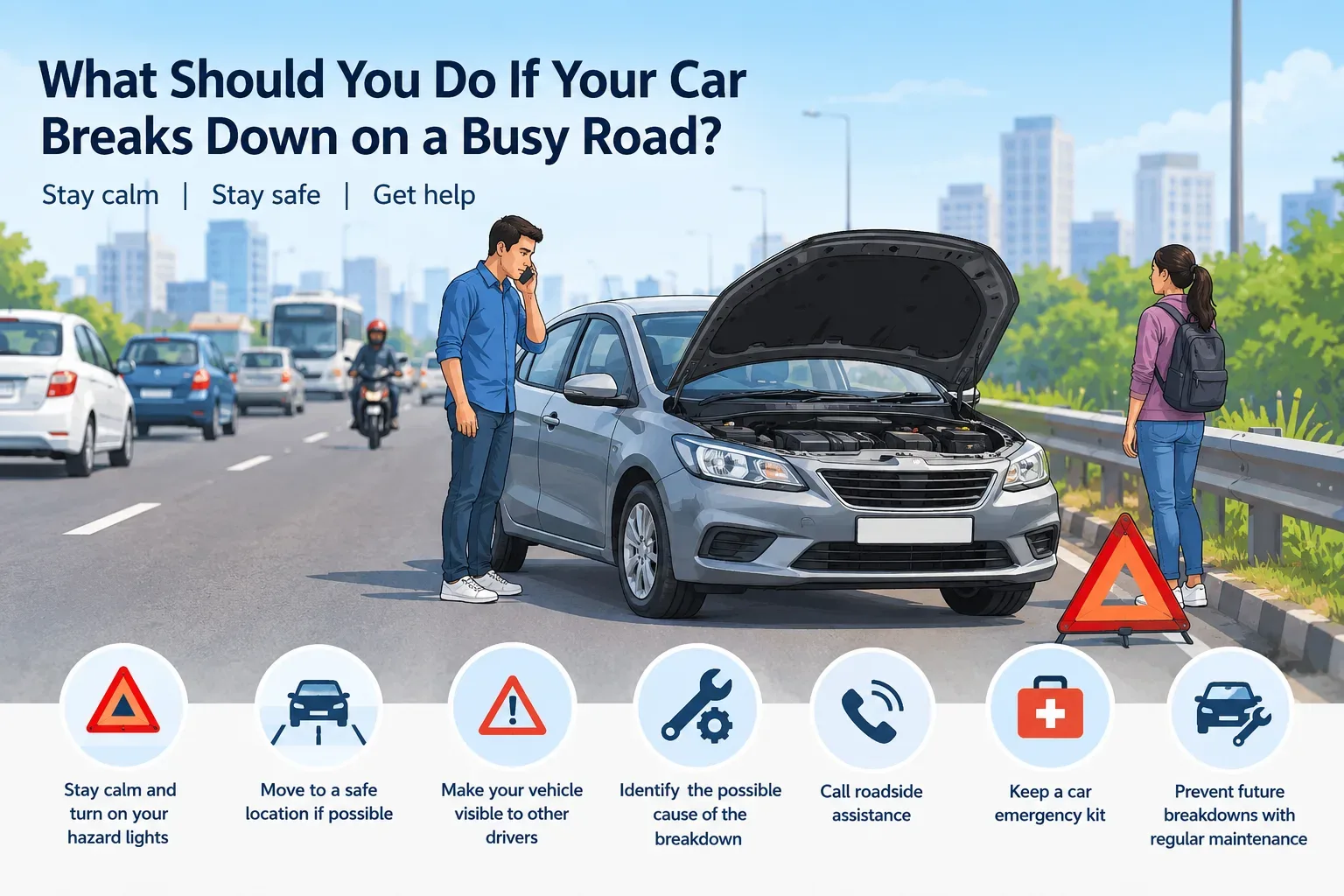
Stay Calm and Switch on Your Hazard Lights
Remain calm and try to maintain control of your car, when it unexpectedly stops functioning. Try to avoid sudden braking, sharp turns, or sudden lane changes because they can cause you to lose control of your vehicle, and potentially lead to a traffic accident.
Turn your hazard warning lights on when it’s possible to do so. Your hazard warning lights let other drivers know you have a problem with your car and you might have to pull over.
Move Your Car to a Safe Location
If you are able to control the direction of your car and can turn it safely, try to move onto the left shoulder of the road, a designated parking spot (lay-by) or another type of parking space in an area with less traffic. Make sure to check your mirrors and use turn signals prior to turning onto the left side of the road.
Do not try to get to the side of the road by making an unsafe move. If your vehicle is stopped in a live lane of traffic, and you are unable to safely pull off the road, turn on your hazard lights and call for help. Do not attempt to push your vehicle across a line of moving traffic.
Make Your Vehicle Visible
visibility is very important when your vehicle has broken down, especially when driving at night, during heavy rainfall, or under dim lighting conditions. you should use your hazard lights if possible. do not stand directly in front of your vehicle or between your vehicle and incoming traffic.
Only use a warning triangle if you can position it without causing danger to yourself. Do not cross over busy roads to set up warning equipment. Your personal safety is of the utmost importance.
Identify the Possible Cause of the Breakdown
Common car issues can be identified so that you are prepared to react correctly. Examples of common car issues include: an overheated engine, dead battery, flat tire, low fuel, odd sounds, and the illumination of the check engine light or other dashboard warning lights.
If you see smoke, smell something burning, or have any other indication of fire; safely pull over as soon as possible, turn your engine off (if safe to do so), and walk away from your car. Contact emergency services immediately if you feel in imminent danger.
Never remove the hot radiator cap from your vehicle. It can cause serious burns from the pressurized coolant.If you are not sure what the problem is with your vehicle, do not try to fix it yourself on the side of the road, but ask for help from a certified mechanic.
Call Roadside Assistance
When you’re in a safe place, call your roadside assistance service provider, your automobile manufacturer’s customer service number, your insurance company’s hotline, or a reputable auto repair shop.Provide your exact location, including the road you are on, nearby landmarks, the direction you were traveling, and any visible mileage markers.
If your car breaks down on a freeway/expressway follow the emergency protocol of the roadway authority. When there is a present danger to life/safety in India, dial 112 for emergency service.
Wait for professional help in a safe place, such as a secure area away from vehicle traffic, when you feel threatened by the presence of a stranger.
Keep a Car Emergency Kit
Having a charged cell phone, a portable charger (power bank), a flashlight, a basic first-aid kit, some drinking water and the telephone number of a road-side service provider with you in the vehicle will help reduce the stress that may be associated with having to deal with an unforeseen problem with the vehicle.
Make sure you check your spare tire, jack, and simple tool set periodically. However, you should only try to fix a flat tire or perform other small repairs on your car if you are able to pull off the road and park in a safe area that is completely free of moving vehicles.
Prevent Future Car Breakdowns
Regularly scheduled maintenance for your car will help to minimize the likelihood of unforeseen vehicle issues. You should check the air pressure in each of your tires; the level of engine oil; the level of coolant; the state of the battery; the condition of your brakes; and the functioning of your lights as per the manufacturer’s suggested schedule for your particular model.
Pay attention to any dashboard warning lights or anything out of the ordinary in the way your car is performing rather than disregarding the initial indications of a problem. Prior to long trips, check over your car and verify that all necessary paperwork and contact information for emergencies will be accessible.
Basic vehicle check learning can be helpful for new drivers as they build confidence and practice safe driving practices.
Conclusion
Knowing what to do when your vehicle has a breakdown on a busy roadway will keep you and your passengers safe as well as those around you. When this occurs, remain calm, turn on your hazard lights, find a safe spot to park (if possible), and call for professional help. Do not put yourself at risk of injury by trying to repair your vehicle while in the middle of moving traffic.
At DriveX Motor Driving School, being a safe driver is about more than just knowing how to use your vehicle. Safety on the road, knowing when there may be a problem with your vehicle, and remaining calm in an emergency are all useful skills that every driver should have. By having quality driving instruction, regular maintenance done to your vehicle, and practicing safe driving techniques, you can become better equipped to handle unexpected events on the roads of India.