
Emergency braking is an important skill that all new drivers should know. You never know when you may have to stop unexpectedly for a traffic stop, a pedestrian crossing, or a vehicle that suddenly stops in front of you. If you know how to stop your vehicle safely, you can react immediately and reduce the chances of an accident.
As new drivers, learning about emergency braking techniques will give us more control of our vehicles, improve our awareness of what is going on around us when we are on the road and give us more confidence as drivers.Beginning drivers who take courses in professional driver education and practice with someone who has experience as a driver will learn how to properly use their brakes in an emergency situation and react quickly to unexpected obstacles or hazards that may appear on the road.
What Is Emergency Braking?
When you apply the brakes as fast as possible because of a sudden threat that causes you to need to come to a stop, this is emergency braking. Emergency braking is different from normal braking because with normal braking, drivers can slowly reduce speed; however, with emergency braking, drivers must immediately and safely react.
Beginner drivers need to know how to safely bring a car to a halt since several factors including reaction time, speed of the vehicle, condition of the road, and braking distance determine how fast a car will be able to come to a stop.
Professional driving instruction allows students to learn about how to stop in an emergency situation and develop safer driving behaviors.
Why Is Emergency Braking Important for New Drivers?
Beginner drivers can have difficulty reacting appropriately when something unexpected occurs on the highway. Driver panic can result in the driver braking too late, making a rapid turn, or losing control of the car relative to other vehicles.
By practicing emergency braking, new drivers will learn how to identify potential hazards, act quickly, and have greater control over their vehicle. Additionally, practicing emergency braking will teach new drivers why they should maintain a safe following distance and adjust their speed based on the amount of traffic and the condition of the road.
Knowing how to stop your car in a hurry (emergency braking) is a fundamental part of defensive driving whether you are driving through a crowded urban area or a quiet residential neighborhood.
Essential Emergency Braking Techniques for Beginners
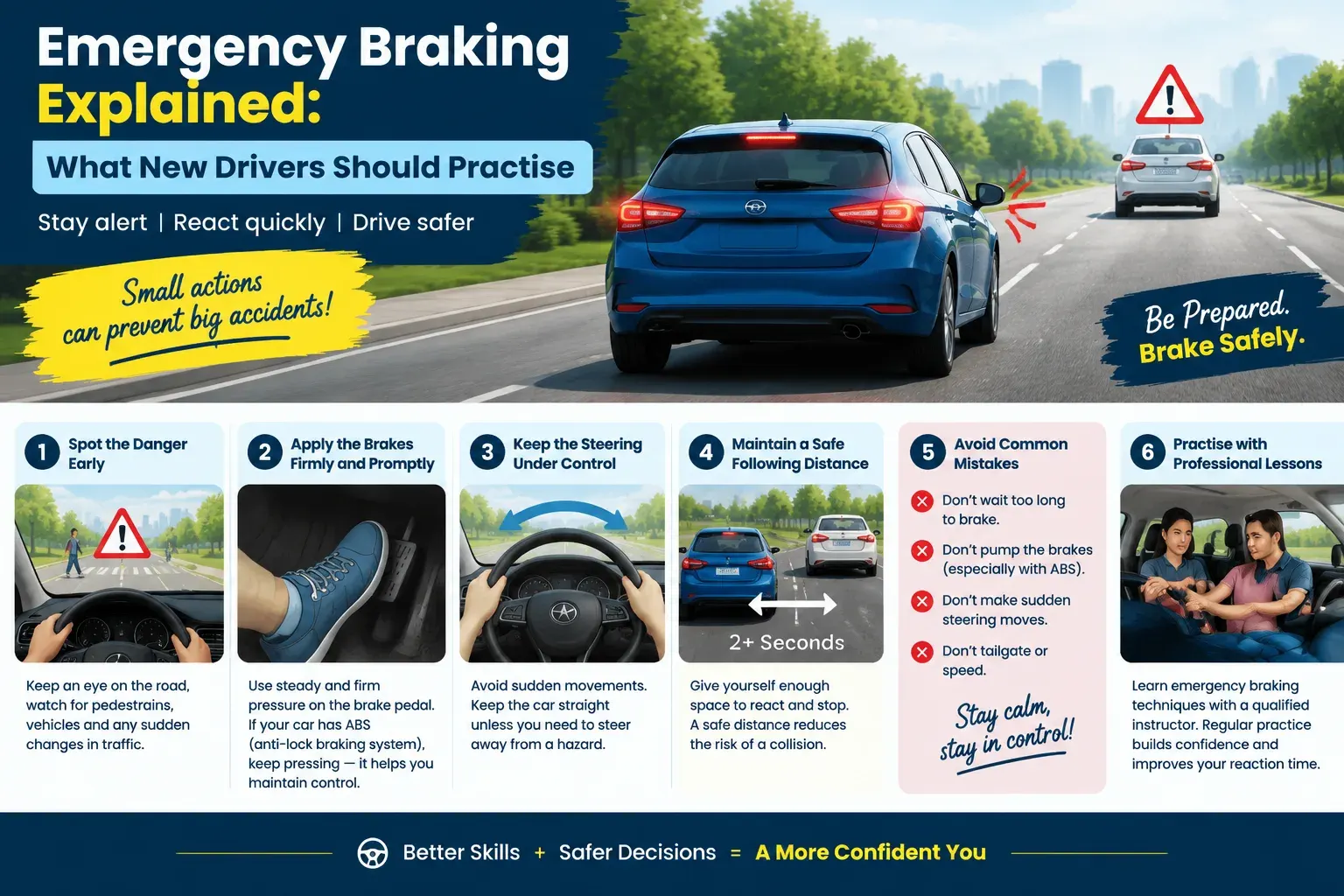
Recognise Hazards Early
A safe emergency brake can start by having good visibility. Be aware of your surroundings, observe what other cars are doing, be aware of people on foot or on bicycles, and pay attention to when a car in front of you could slam on its brakes.
Early identification of potential hazards will allow you to make decisions faster and reduce the chance of slamming on the brakes. Awareness of what is going on around you is a basic skill that is practiced in most beginning driver’s education courses.
Apply the Brakes Firmly and Promptly
If you need to make a rapid halt, press the brake pedal with force and without delay. Do not try to analyze all parts of the event before making a decision.
To make a fast emergency stop in a car that has an Anti-lock Braking System (ABS), continue to apply firm and steady force to the brake pedal. The ABS will help to prevent your tires from locking up and therefore give you better steering control. During an ABS-assisted stop, you may experience some vibration or pulsating at the bottom of the brake pedal, which is typical for ABS to function.
When you drive a non-ABS equipped vehicle, you should always refer to the vehicle manufacturers instructions for proper use of the brakes. Also, remember to take your driving instructors advice regarding how to stop safely.
Keep the Steering Under Control
In an emergency brake situation, make sure you can control your car’s direction. Do not turn the steering wheel quickly unless you are trying to get away from a dangerous object that is close to you and you have a clear, safe way to go.
Abrupt steering causes a vehicle to lose control when it is on a wet or slippery road. Effective use of both steering control and effective braking will help make driving safer.
Maintain a Safe Following Distance
When traffic suddenly comes to a stop, having sufficient space between your vehicle and the one in front of it allows you extra time to react.
The total distance needed to come to a complete stop is composed of two parts: the distance that will be covered during your reaction time, and the distance that the vehicle needs to come to a stop once you start applying the brakes. Factors such as travelling at higher speeds, driving on wet roads, using worn tires, and having poorly maintained road surfaces will all contribute to increasing the amount of space needed for a vehicle to stop.
Common Emergency Braking Mistakes to Avoid
One frequent error made by drivers is to delay when they apply their brakes. Delaying to use your brakes will make it more likely that you have an accident.
Another error that can occur during a firm stop, occurs when the driver applies pressure to the brake pedal in an inconsistent manner. It is essential for each driver to be aware of how his/her car’s braking system operates, and then practice applying the appropriate amount of pressure to the brake pedal under the guidance of a qualified instructor.
Never practice emergency stops in public areas unless you have an actual reason. Do not tail gate, speed, or focus solely on what is in front of your car. These three actions will decrease how much time you have to recognize potential problems and respond appropriately to them.
Why Professional Driving Lessons Matter
Professional driving instruction provides an organized approach to learning about proper braking techniques, effective steering controls, defensive driving practices, and general road safety. A skilled and experienced driving instructor will be able to recognize your errors, demonstrate how to properly brake, and help you gain confidence as a driver.
Learners who wish to learn basic driving skills and gain a better understanding of how to drive safely should consider the DriveX Motor Driving School. When learning to drive, selecting the right type of training will help you prepare for real-world driving conditions in a responsible manner.
Conclusion
All beginning drivers need to learn how to use the emergency brake. Developing an early awareness of hazards, learning to properly use your brakes, keeping control of the steering wheel and having enough room between you and other cars will help beginning drivers react more effectively in emergency situations.
In addition, as students attend driver’s education courses and have an experienced adult supervise their driving, they can gain experience with properly applying brakes, and developing responsibility as a motorist. Learning how to properly apply the emergency brakes during emergencies is essential for becoming a safer driver and ultimately decreasing the chances of having an auto accident.